The Stillbody Moves Their Finger: Resignation in Childhood and Marina Abramović’s Rhythm 0
Movement is a dangerous thing. As a child acclimated early on with parental-familial law and an understanding, whether or not I consistently applied it, that to roam past certain boundaries meant either a backhand or a humiliating confrontation in front of other people, I gradually made more use of that age-old avoidance tactic: staying still, first popularised (not really) by the Buddha and then by Steven Spielberg. Stillness! How you had propped me up during those salad days as an exhibition of a well-behaved, well-restrained child! Those people whose opinions superseded everything else in the eyes of Daya and Baba – they must have thought you were hot shit.
To be fair, my parents certainly did not expect me to exercise near-perfect stillness on top of a vow of silence, let alone calculate that I would cast most manners of movement into a no-man’s land. The years pulled on, guests came and went, friends became uninterested, while I sat – different clothes on, probably some taller – offering the same, fledgling scraps of conversation. On my parents’ side, pride in a well-behaved youth gave way to embarrassment at my stubbornness, my ego; albeit I was more embarrassed than anyone could ever be for my sake. Still, my body groaned, movement is a dangerous thing.
If I considered being any different, I was immediately contradicted by the manner (practiced to perfection) in which my limbs locked into place. Resolute, proving to me that the initial avoidance tactic had crystallised into habit. That’s how it goes, I guess. When I received my first pair of headphones – which I undeniably assaulted with terrible music – my commitment to this objecthood became far more manageable, and I contented myself with the hope that I’ll be left to phase into my environment, relegated to one’s peripheral view at best. However, I didn’t realize at the time that I would never be able to find a specially designed paradiseᵀᴹ in utter stasis.
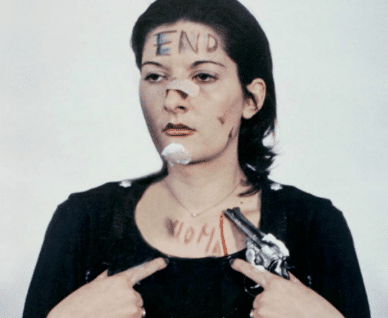
In illustrating this point, I won’t avoid the performance-art sphere, where creatives may adhere to or exploit such debilitating fears. In particular, Serbian artist Marina Abramović demonstrated the precarious life of social passivity in the postlude of her Rhythm series, titled Rhythm 0. An auditor entering the Galleria Studio Mora (in Naples), on the 23rd of November ’74, would have been met with miscellaneous items set on a table – roses, beverages, rope, weapons, etc. – and instructions: ‘There are 72 objects on the table that one can use on me as desired … I am the object … during this period I take full responsibility.’ The artist was present and unmoving.
Lasting six hours, Rhythm 0 posited an experiment of trust between performer and audience – Abramović relinquishing creative control to the latter, offering herself up as a canvas of flesh and blood. What began initially as a semi-sluggish showcase of human curiosity gave way to harsher, more apathetic undertakings on the part of the predominantly male audience, as relayed to us by American art critic Thomas McEvilley:
Someone turned her around. Someone thrust her arms into the air. Someone touched her somewhat intimately. The Neapolitan night began to heat up. In the third hour all her clothes were cut from her with razor sharp blades. In the fourth hour the same blades began to explore her skin … When a loaded gun was thrust to Marina's head and her own finger was being worked around the trigger, a fight broke out between the audience factions.¹
Abramović’s soldierly commitment to her art seemed to block out even her thanatophobia; she considered later on that the presence of female auditors was probably her sole protection against rape, which McEvilley convincingly suggests ‘she would not have resisted.’ Rhythm 0 is a bold bodily sacrifice above all. With its constituents of objecthood and lawlessness, leaving the audience to bask in a freedom made permissible only by an individual’s impudence, Abramović’s experiment surely re-enacts an oppressor-oppressed relation. Her total resignation allowed for near-unmitigated, misogynistic violence – that aforementioned paradise was nowhere to be found. Resignation will be taken for easy access.
Some concessions, however: while I would like to pretend that my childhood was also a reprise of Lord of the Flies (and capitalise on it via Dr. Phil) … it was definitely not. While Abramović engaged her spectators in infringing upon her body, fashioning a narrative out of the physical and mental hurt she underwent, I sought the opposite. I sought invisibility and I sometimes found it, too. Other children realize, more than adults do, that movement is high-risk and yet they keep on moving – like a self-sustaining circuit reveling in what little space it occupies. On the other hand, I believed that I (like a ‘tree among trees, a cat among animals,’ says Albert Camus²) had declined into a tranquil, if idle, stability.
But if human instinct is anything to go by, such patterns of behaviour can’t survive for long. The circuit will soon tire, since it has been given more space and responsibility, now resembling my kid-self at times. And persisting in stasis couldn’t go on either – not without inviting all the issues that come with extreme self-repression, which exit cracks in the stillbody’s almost adamant soul. A sudden hunger to claw at the world around you, for any sight, feeling, sound to take home with you. Where does it come from, this hunger? Where will it go?
At 2 AM, on the 24th of November ‘74, the gallery supervisor announced the conclusion of Rhythm 0. After six hours of endurance, Marina Abramović assumed the appearance of life at last – and, in her own words recounting the experience, ‘everybody ran away … people could not actually confront me as a person’.³ Bruised and humiliated, she posed no real threat to them except as a mirror of the cruelty they were capable of. Seeing her autonomy for the first time injected the studio with a sense of law. Their reaction, compared with the increasing willingness with which they utilized the instruments on the table, makes it so: movement is a dangerous thing.
1. Thomas McEvilley quoted in: Ward, Frazer. No Innocent Bystanders: Performance Art and Audience / Frazer Ward. Dartmouth College Press, 2012.
2. Camus, A., & O’Brien, J. (1955). The myth of Sisyphus by Albert Camus; translated from the French by Justin O’Brien. Hamish Hamilton.
3. “Marina Abramovic on Rhythm 0 (1974).” Vimeo, 8 Aug. 2013, vimeo.com/71952791?share=copy.